
EUDR and the TRACES Platform:
Written by Florent Scarpa, PhD. Data Scientist at Sustaain
Key Takeaways
EUDR compliance is decided long before a shipment leaves. Most of the work lies in organizing traceability, deforestation and legality data for every batch, ideally in an EUDR due diligence platform built for messy supply chain data. Submitting the Due Diligence Statement (DDS) in TRACES then brings its own hurdles: cryptic errors, an unstable API, and inconsistent geolocation data that pass without raising any flag. After submission, status changes, the 72-hour amendment window and DDS grouping still need active follow-up. This article walks you through these blocking points and how to anticipate them.
The EUDR applies from December 30, 2026 for large and medium-sized operators. Many actors are still rushing to build their auditable compliance platforms. Others entrust compliance providers to help them with varying blocks of the compliance chain.
Most are still left struggling to manage the pressure of the EUDR pipeline. On one end, they must force the complexity of real supply chains to fit inside simplistic software data models. On the other end, they must keep their data flowing while legal guidance, IT systems and technical requirements are still evolving.
Before the DDS: 90% of EUDR Compliance Is Done Upstream
Most of the compliance work happens before anything is shipped. Shipping a batch that you are not 100% sure is compliant is already a failure. You are exposed to fines under the regulation and to goods held at customs. As a result, you may be unable to deliver to your clients. You also risk penalties from clients and reputational damage.
The amount of information necessary to start assessing the first-mile traceability of a shipment, the absence of deforestation and the legal production of the goods is colossal. Organizing this information in a digital platform and tracking the progress of data collection campaigns and compliance checks is where sustainability teams start to struggle. The job requires as much data expertise as operational expertise.
This is the gap many software vendors try to fill with plug-and-play platforms. Their data models range from oversimplified generalist tools to complex, rigid graphs. In practice, the former never fit the natural complexity of real-world supply chains, and nobody can use the latter, because the data is never clean or complete enough.
This is why at Sustaain, we built an EUDR due diligence platform that is straightforward enough to give you what you actually need:
Intuitive forms and models that do the job to centralize your compliance data
Flexible data models with granularity adapted to the complexity of your supply chains, while keeping compliance rules strict
Clear status checks and monitoring dashboards on compliance levels at contract and plot level
Close consulting with business and data experts to help you get started with your messy supplier data, train users and adapt workflows to your specific needs
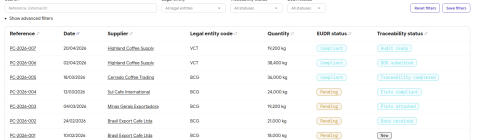
Contract-level EUDR compliance statuses in the Sustaain platform

Plot-level EUDR compliance statuses, including Serasa for Brazilian plots
During the DDS: Due Diligence Statements Are as Good as You Make Them
Once all data is gathered, all checks pass and all lights are green on your batch, you might think submitting the DDS is a quick and easy end of the journey.
And it may look like it. After registering as an Operator on TRACES, the EUDR Information System, you just need to log in and fill in the submission form. The form itself is rather simple. It is only a statement that you duly checked the absence of deforestation risk on the commodity you want to place on the EU market. The amount of information therefore is minimal:
nature and volumes of the commodity
country and geolocation coordinates of the plots of land that produced the commodity
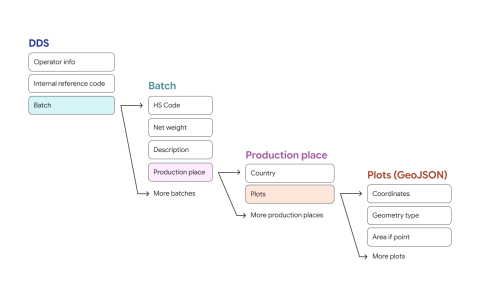
The minimal structure of an EUDR Due Diligence Statement
The struggle usually starts with plot coordinates and the (un)spoken rules of the TRACES platform. Even with a sound GeoJSON file of all your plots, you can still hit cryptic error messages. Some point to bad geometries or an oversized payload. Others are generic uncaught exceptions that leave everyone scratching their heads.

A generic TRACES server error. As a software team, we know it happens to the best of us
If you have more IT capability and choose to connect the TRACES API to your systems, you gain programmatic submission capabilities but lose the guidance of the submission form. The interaction becomes even less forgiving. Authentication as a web service user for a registered operator can be tricky and requires email exchange with the support team. Any error, such as declaring a mass uncertainty on an import statement, gets your payload rejected.
In other words, TRACES is strict on format but lenient on substance. Much more worrying is the following question: can a successfully submitted DDS contain bad data? Did you ever test if inconsistent data can run through TRACES with no warning? We did, and the answer is ‘oh yes it can’.
What Our TRACES Benchmark Found
Here is a collection of scenarios tested by our TRACES benchmark that pass a DDS submission or get modified without raising any flag, at the time of writing:
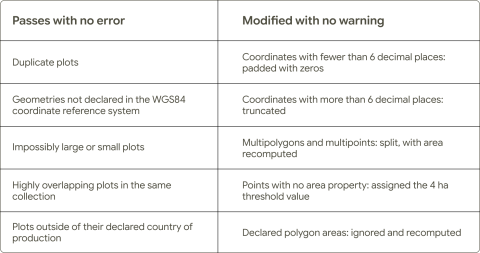
Some of these are clearly flagged by the Competent Authorities as non-compliant with the regulation and will get you in trouble at audit time. So you need to be your own police and make sure the data you submit is actually realistic. Relying on TRACES for that part of the due diligence process or the storage of your coordinates is a trap that could cost you dearly.
We specifically mentioned that the inconsistent rules we flag exist ‘at the time of writing’. Indeed, those are prone to change over time when new updates roll in, increasing further the uncertainty around how the regulation is implemented.
That is why in addition to having a thorough geometry issue detection & remediation pipeline, Sustaain also regularly benchmarks the TRACES platform and API behavior against all corner cases. Our Deforestation Risk Assessment and Geometry Validation module tells you if your geometries are safe and sound. Our TRACES benchmark tells us if they pass the final gate. We use the latter to adapt the rules of the former, so that our geometry checks are always a reasonable superset of the TRACES checks.
Whether you use our assisted DDS generator for manual submission or let Sustaain submit on your behalf through the API, the outcome is the same. When the EUDR button becomes clickable, your data has passed checks designed to be reasonably stricter than TRACES’ and is formatted to register successfully in TRACES, so your submission is set up to land smoothly.
After the DDS: EUDR Compliance Continues Past Submission
Once you have successfully submitted a DDS, the job is not finished. You then need to wait for your DDS status to move from ‘SUBMITTED’ to ‘AVAILABLE’. In our experience, this takes anywhere from 5 minutes to a couple of hours. Only then can you get the official identification number of the DDS, which you need to provide to downstream operators. This status change also starts the 72-hour window during which you may amend or withdraw your DDS.
Based on your internal organization, you may prefer using the grouping feature recently introduced in TRACES, which allows you to create a ‘Group Head’ DDS that references other previously submitted (and available) DDS. The group head replaces the other DDS as the one with legal value, while the latter are frozen sources of information. Even if you do not hit the size limit, you might still use the grouping feature to reference a group that makes sense to your logistics with a single declaration.
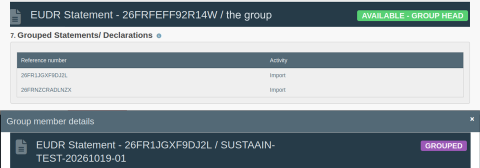
Grouping in TRACES: the Group Head becomes the DDS with legal value, while referenced DDS get a ‘Grouped’ status and are frozen
If you ran a manual submission, you also need to report that submission to your internal systems in order to keep track of what commodities have been declared or not. Sustaain keeps track of what is compliant but also what is declared, and reminds you of what information you need to backfill when you manually submit your DDS.
If you submit your DDS through the Sustaain platform, we automatically keep track of that information for you in addition to running the submissions. We can also automatically split and group your DDS if they are too large at submission time, or let you organize your groups in our platform.
Finally, compliance is not just your problem as a primary operator, it is a matter of trust and reputation for your clients. This is why Sustaain also gives you the possibility to generate Information Sheets on the commodities you place on the EU market. They provide the right level of information to prove to your customers that we did run the due diligence process thoroughly, together.
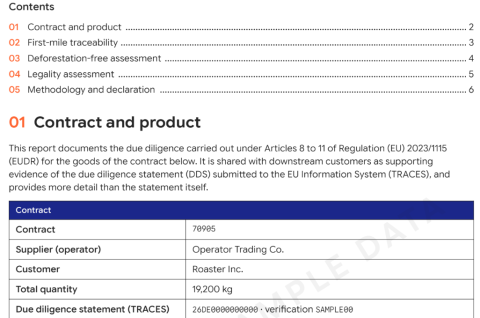
Sample Information Sheet (IS-DDS) generated by Sustaain
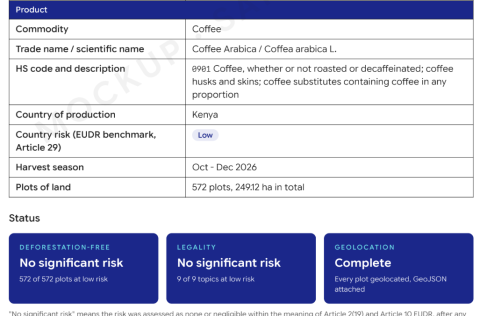
Product and compliance summary in the Information Sheet
We are working on extending this capacity to high-level-of-detail audit reports that will allow you to seamlessly pass audits in the future. We first built to make sure the data you submit to us is compliant and remains available to protect you from any financial and reputational risk. Now we build so that you don’t waste any time sharing the message that will reassure stakeholders and keep the fines at bay.
Check Your Data Before TRACES Does
The EUDR Due Diligence Statement is the visible part of compliance, but most of the risk sits around it. Before submission, your data must already be complete, consistent and traceable down to the plot. During submission, TRACES can accept inconsistent or unrealistic geolocation data without any warning. After submission, status changes, the 72-hour amendment window and DDS grouping still need active follow-up.
With the December 30, 2026 deadline approaching, the teams that move fastest will be the ones that check their data before TRACES does, not after.
Want to see where your own supply chain data could break? Book a demo: we come with a working hypothesis on your highest-exposure origin.

Read more
-
EUDR Supplier Risk Assessment: From Questionnaire to Contract Allocation
-
From field data to business decisions: XLSForm
-

Volcafe entrusts Sustaain for their EUDR compliance portal
-

From EUDR Paperwork to One Data Model
-

Sustaain Partners with Odds for EUDR & CSRD Compliance
-

Sustainability Reporting in Commodity Supply Chains