
Sustainability teams aren't drowning in reporting.
Written by Estelle Rambier, Lead Data at Sustaain
A few weeks ago, I was sitting next to an analyst who was preparing a customer report. I watched her for a bit longer than I meant to, mostly because I was curious what "preparing a report" actually looks like in practice.
She wasn't calculating anything. She wasn't looking for trends. She definitely wasn't making decisions. She was copying things. An invoice from one folder. A Bill of Lading from another. Shipment data from the ERP. A certificate that someone had emailed her at some point. A polygon from a GIS tool that I'm fairly sure nobody else on the team knows how to open.
None of it was hard. It was just repetitive, in the way that makes an hour disappear without anything to show for it.
I've started to think this isn't really reporting. It's translation.
The data collection isn't the problem
People like to say sustainability reporting is a data collection problem. I don't think that's quite right. Most companies already have the data somewhere. It's scattered across systems that were never built to talk to each other. The ERP knows the shipments. The survey tool knows the farmers. The document repository knows the certificates. The GIS platform knows the polygons. Then a customer asks for an Excel file, the EU asks for an EUDR Due Diligence Statement, and the sustainability team ends up in the middle, translating.
What strikes me is that nothing underlying changes. The shipment is the same shipment whether it goes to a chocolatier or a regulator. Only the format changes. Yet every new customer seems to trigger a brand new reporting process, as if starting from scratch.
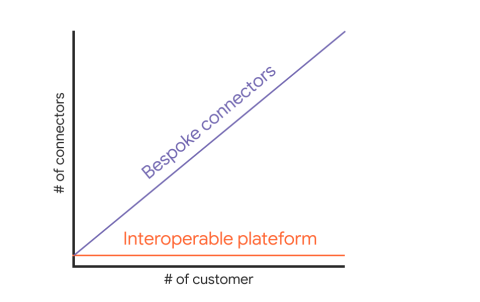
The cost of bespoke integrations
Take a coffee exporter with twenty buyers, each with its own template, portal, and idea of what counts as a "farm." The coffee hasn't changed. Only how someone wants to consume information about it has changed. So why rebuild the whole pipeline each time?
A trick borrowed from software engineering
Engineers ran into this decades ago. When two systems need to talk, you don't integrate every system with every other one, that doesn't scale. You define a common interface instead, so each system speaks one language, and adding a new one becomes cheap. That's the shift from integration to interoperability, made concrete.
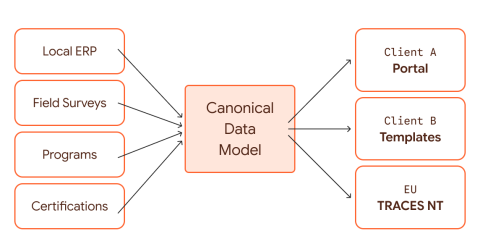
One model to rule them all.
Documents are just another interface
There's a tendency to frame AI's role here as "reading PDFs," and I think that undersells it. A PDF is just another interface, optimised for humans rather than machines. Extracting text from a Bill of Lading isn't the hard part. The hard part is recognising it contains information your system already has a place for, once that place is defined. The document disappears. What's left is information, sitting in the same interoperable model as everything else.

Document-centric

Information-centric
A different job for sustainability teams
This changes what a sustainability team is for, I think. Today, a lot of the time goes into integration work: moving information from one place to another, one customer at a time. I'd rather see it go into checking whether that information is correct. Only one of those jobs scales with business complexity rather than the number of reporting formats.
This is what we're building at Sustaain for EUDR and beyond
This isn't a hypothetical fix, it's the model we're building at Sustaain, and it's already compounding. As the customer base of our customers grows, we're not rebuilding the pipeline for each new one; we're extending the same interoperable core: more connectors live, more formats recognised, more documents extracted with higher accuracy, deeper integration into the systems our customers already run on. Every new customer adds to what the model understands, none adds a new project. That same interoperable core is what turns a Bill of Lading or a certificate into an EUDR-ready Due Diligence Statement, without a new project for every regulation that comes next.
That's the difference between integration and interoperability at scale. Integration gets you one window. Interoperability gets you all of them, and every customer after that one for free.
A good building block system doesn't need a new piece for every model. It just invents new combinations from the same underlying system.

Read more
-

Volcafe entrusts Sustaain for their EUDR compliance portal
-

Sustaain Partners with Odds for EUDR & CSRD Compliance
-

Sustainability Reporting in Commodity Supply Chains
-

Geospatial Data Quality at Scale: A Framework from Detection to Decision
-

Managing Traceability Risk in EUDR Compliance
-
2026 - The year nothing happens, yet everything shifts